
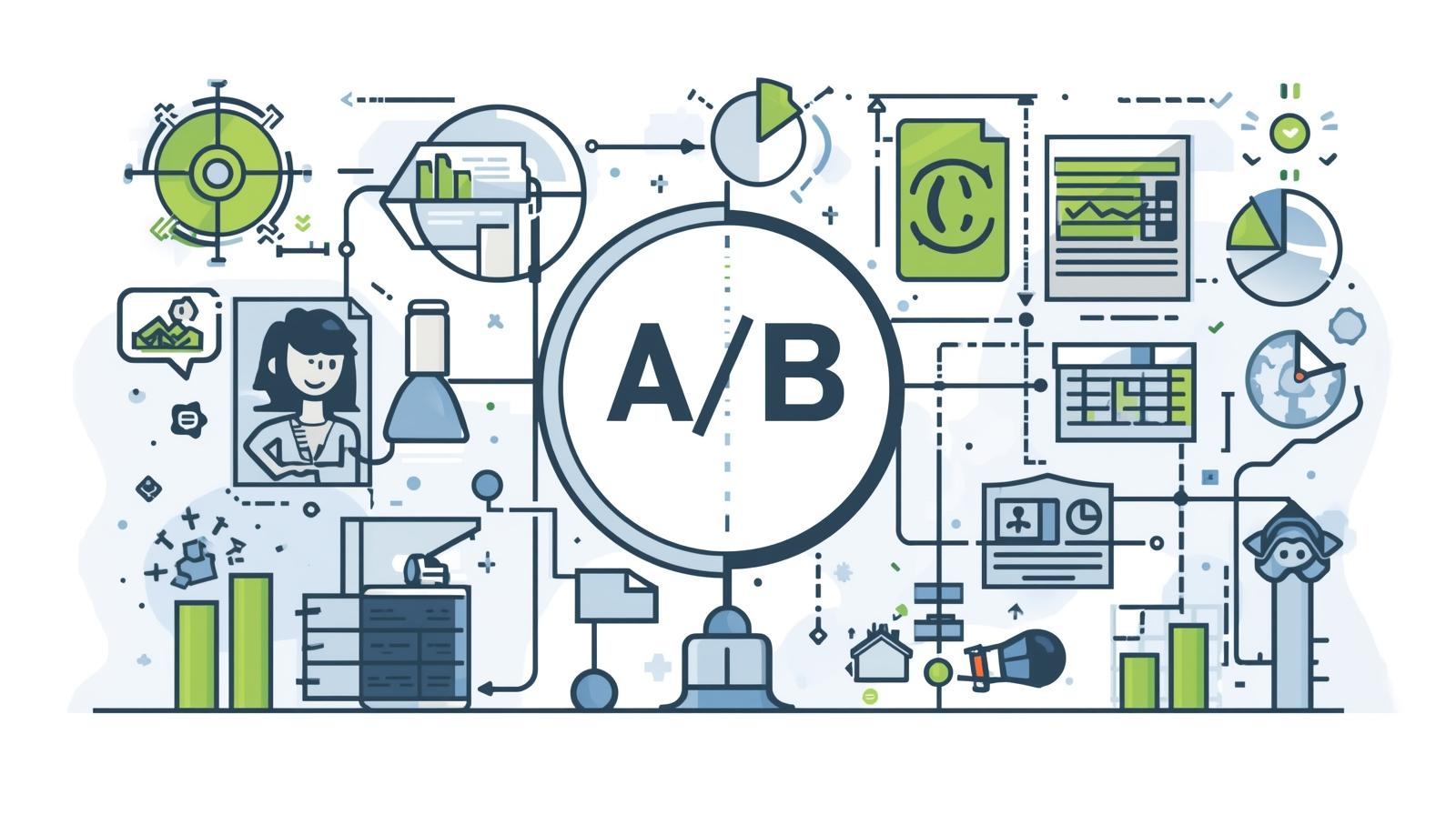
In the realm of lead generation, intuition is often a dangerous guide. Marketing leaders frequently fall into the trap of “Subjective Certainty” the belief that a specific headline or a certain color palette will resonate with an audience simply because it appeals to their own aesthetic. However, A/B testing (or split testing) strips away this subjectivity, replacing “I think” with “I know.” It is the process of showing two versions of a single variable to different segments of your audience to determine which one drives more conversions. By applying the scientific method to your marketing funnel, you transform your lead generation from a series of educated guesses into a disciplined, data-driven engine.
A/B testing provides a safety net for your budget. By testing small changes before scaling a campaign, you ensure that your marketing spend is allocated to the highest-performing assets, significantly lowering your Cost Per Acquisition (CPA).
Formulating the Hypothesis: The Architecture of the Test
A common mistake in A/B testing is changing too many elements at once, resulting in a “Muddied Variable.” If you change the headline, the call-to-action (CTA), and the background image simultaneously, you may see an improvement in performance, but you will have no idea which change caused it. A professional testing framework begins with a clear hypothesis: “If we change the headline from a ‘Benefit-Led’ approach to a ‘Loss-Aversion’ approach, then our click-through rate will increase by 15%.” This level of specificity allows you to isolate the psychological triggers that truly move your target audience.
Isolate one variable at a time. Whether it’s the color of a button or the wording of a lead magnet, keeping your variables pure is the only way to gain actionable insights that can be applied to future campaigns.
High-Impact Variables: Where to Focus Your Energy
Not all variables are created equal. While testing button colors is a classic example, it rarely moves the needle as much as testing the “Offer” itself. In B2B lead generation, the “Lead Magnet” is often the most significant lever. You might test a “10-Page Industry Report” against a “3-Minute Interactive Diagnostic Tool.” Often, the friction of reading a long document is higher than the friction of an interactive tool, even if the data provided is identical. Beyond the offer, the headline and the primary CTA should be your priority, as these are the first (and sometimes only) elements a prospect interacts with before deciding to stay or leave.
Prioritizing high-impact variables prevents “optimization fatigue.” Focusing on the elements that dictate the prospect’s value perception,the headline and the offer yields much higher ROI than obsessing over minor cosmetic tweaks.
The Threshold of Truth: Understanding Statistical Significance
One of the most frequent errors in testing is “Calling the Game Too Early.” If Version A gets five sign-ups and Version B gets eight after only 100 visitors, it is tempting to declare Version B the winner. However, this is often a result of “Natural Variance” rather than a true preference. To make a business decision, you must reach Statistical Significance, usually a 95% confidence level which indicates that the results are likely not due to chance. This requires a sufficient sample size. Without this mathematical rigor, you risk scaling a “False Positive,” which can lead to a drop in performance once the campaign reaches a larger audience.
Use a statistical significance calculator before making any changes. If your traffic is low, run your tests for longer periods (e.g., 2–4 weeks) rather than aiming for a specific number of clicks. Patience is a prerequisite for accurate data.
Beyond A/B: The Multivariate Horizon
For organizations with high-traffic volumes, Multivariate Testing (MVT) offers a more complex alternative. While A/B testing compares two versions of a single element, MVT tests multiple combinations of multiple elements simultaneously to see how they interact. For example, how does a specific headline perform when paired with a specific image? This “Interaction Effect” can reveal nuances that a standard A/B test might miss. However, for most small-to-mid-sized teams, the simplicity and speed of A/B testing remain the most effective way to iterate.
MVT is a powerful tool for fine-tuning a “Winning” page that is already performing well. However, if your campaign is new, stick to A/B testing; it provides clearer, faster signals about what is working at a foundational level.
Conclusion: The “Forever Beta” Mindset
A/B testing is not a one-time event; it is a perpetual state of mind. The market is not static, competitors enter, customer tastes evolve, and “Ad Fatigue” sets in. A campaign that wins today may become obsolete in six months. The most successful lead generation teams operate in a state of “Forever Beta,” constantly challenging their own “Control” version with a new “Challenger.” By fostering a culture of experimentation, you ensure that your lead generation strategy remains resilient and continuously optimized for the modern buyer.
Never stop being the “Challenger.” Even when you find a winning version, immediately start thinking of how to beat it. Continuous iteration is the only way to maintain a competitive edge in a crowded digital landscape.